.png "Aries")
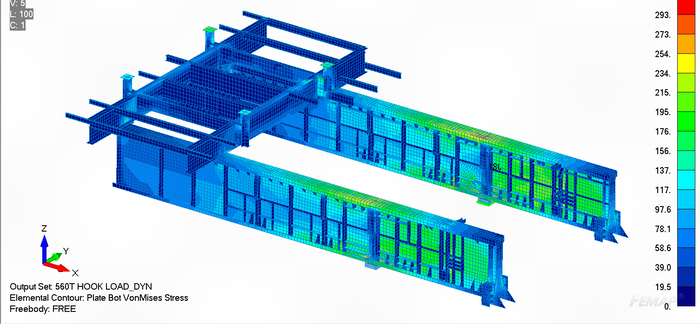
Finite element analysis(FEA) is a tool suited for validation and optimization in all fields of engineering. FE experience involving global models as well as microengineering aspects of connection details have been carried out to client satisfaction. Requirements of FE analysis arises in various engineering problems associated with offshore structures including new designs, conversions, upgrades, life extension, decommissioning etc. Various global or local finite element models are developed in these projects to accurately simulate the linear/non-linear structural responses under complex loading conditions. FEMAP, SACS, Moses etc. are just a few of the software that are employed by our experienced team of engineers for finite element applications.
Finite element analysis is typically required for offshore engineering problems involving new designs, conversions, upgrades, life extension studies, and decommissioning. Aries Energy's FE work spans both global models of complete structures and microengineering-level analysis of connection details, letting the same technique support projects at very different scales within the same offshore engineering scope.
Aries Energy develops both global and local finite element models for offshore structures, depending on what the project requires. Global models assess the overall structural response, while local models focus on specific connection details, and both are used to simulate linear and non-linear structural responses under complex loading conditions.
Aries Energy's finite element analysis work is carried out using software including FEMAP, SACS, and MOSES, among other tools used across its offshore engineering division. These support both global structural models and detailed local connection analysis, covering the range of FE applications needed across offshore design, conversion, and reassessment projects.
Yes. Finite element analysis is one of the engineering problems Aries Energy explicitly lists as a driver for FE work, alongside new designs, conversions, upgrades, and decommissioning. This lets FE modelling feed directly into a life extension study, where it's used together with fatigue and global strength analysis to assess the structure's current condition and remaining capacity.
